Lifestock’s Long Shadow
Livestock’s Long Shadow
Dr Henning Steinfeld is an agricultural economist working at the UN as the head of the livestock analysis and policy section. In 2005, he was the lead author of a 400 page UN report Livestock’s Long Shadow. 1
It stated that the biggest contributor to environmental damage was livestock agriculture. Livestock agriculture includes poultry – both meat and egg production. It is a bigger contributor than transport. The information below is sourced from the document which is available for all to read.
Atmospheric Damage
Animal agriculture is responsible for 18 percent of the world’s greenhouse gas emissions which includes CO2, methane and ammonia.
Land Damage
Livestock grazing accounts for 26% of the available surface of the planet. Area dedicated to producing feed crops for these animals amounts to 33 percent of the total arable land.
Clearing forests to create new pastures is a major source of deforestation. 70% of former rainforests in the Amazon have been turned over to grazing.
Water Damage
The livestock is the most serious users of the earth’s scarce water resources which disturbs water cycles. Significant amounts of water are withdrawn for the production of feed.
Species Loss
Livestock is also an important contributor to biodiversity loss.
An important contribution of livestock’s over-exploitation of the earth’s resources is in the production of fish-meal for livestock feed. 7 of the 10 most fished species, accounting for 30 percent of the world total marine capture fisheries production, are either fully exploited or over-exploited – not sustainable. 2
Nitrogen and phosphorous from agriculture into waterways and oceans is still increasing with mangrove forests, coral reefs and sea grass beds being severely affected. Sea grass beds are very important nurseries for many species including fish, turtles and large mammals (dugong, manatee). Sea grasses environments are under threat in the Caribbean, Gulf of Mexico, the Mediterranean, both sides of the Northern Pacific, large areas of the Indo-Pacific region and extensive areas of Northern Australia.
Over-exploitation of Ocean’s Resources
80% of the world’s fish stocks are fully exploited or over-exploited. 3
In 2006, 36% of the total world fisheries catch was destined for non-food use. It was used for fish meal and fish oil for animal foods. 4
These small pelagic (open ocean), low-value fish form the bulk of fisheries catch destined for non-food uses with the aquaculture sector being the largest consumer utilising 26% of the total catch. These are often taken as a by-catch of fishing operations and varies depending upon location and season. Most of these small pelagic fish (73%) are anchovies, sardines, herrings, pilchards and related fish. Several species are either fully-exploited or over-exploited. 5
Fishing Subsidies
Fishing subsidies greatly distort the fisheries market. In 2009, 6
- Global fisheries subsidies were estimated to be US$35 billion. The total revenue from the industry is US$90 billion.
- Harmful subsidies constituted US$20 billion consisting of fuel subsidies, management, port and harbour tax relief and equipment modernisation.
- US$11 billion is spent on beneficial subsidies such as research with the remaining having unknown impact.
US$35.4 billion of global fishing subsidies were provided in 2018. 64% (group C) were benedicial to the fishing industry in that it allowed a greater catch of the dwindling resource, whilst 30% (group B) were beneficial and 10% (group A) were ambiguous. 7

The 2040 documentary shows black and white Holstein-Friesian cattle contentedly grazing. The next step, where that cattle are headed for the abattoir, is avoided. Apart from the unnecessary suffering, there is a substantial increase in the transport costs, utilisation of water and the disposal of waste products.
World-wide, this was the fate of billions of animals in 2016.
- Chickens: 16 billion
- Pigs: 1.5 billion
- Sheep: 550 million
- Goats: 450 million
- Cattle: 300 million
Most of the grains grown in Australia is produced for export and for the feeding of livestock. 8

Why grow wheat, corn and soy to feed cows, then kill the cow and eat the meat when it is much more efficient to eat the corn?
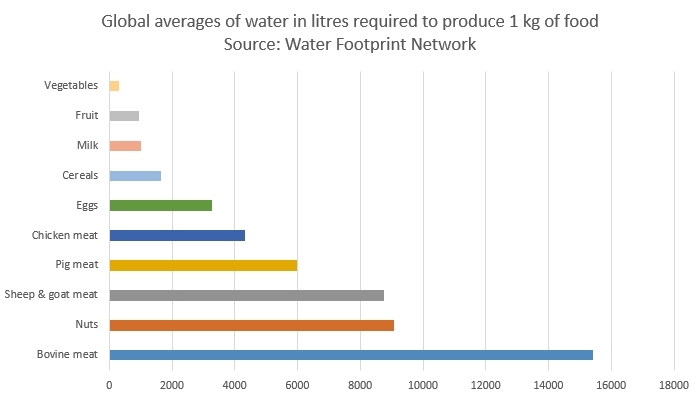
Below is a graph showing the consumption of water in producing our food. 9
Last updated on Sunday 21 June 2026 at 08:38 by administrators
Post Type: postFootnotes
- Steinfeld, H. et al. (2006) Livestock’s long shadow. FAO, Rome. 2006.
- Peruvian anchoveta, Alaska pollack, skipjack tuna, Atlantic herring, blue whiting, chub mackerel, Chilean jack mackerel, Japanese anchovy, large head hairtail and yellowfin tuna
- United Nations. (2010, May). General facts regarding world fisheries.
- Tacon, A. G. J. & Metian, M. (2009) Fishing for Aquaculture: Non-Food Use of Small Pelagic Forage Fish—A Global Perspective. Reviews in Fisheries Science. 17 (3), 305–317.
- Tacon, A. G. J. & Metian, M. (2009) Fishing for Aquaculture: Non-Food Use of Small Pelagic Forage Fish—A Global Perspective. Reviews in Fisheries Science. 17 (3), 305–317.
- Sumaila, U. R. et al. (2016) Global fisheries subsidies: An updated estimate. Marine Policy. 69189–193.
- Schuhbauer, A. et al. (2020) The global fisheries subsidies divide between small-and large-scale fisheries. Frontiers in Marine Science. 7 (1), 792
- Spragg, J. (2016) Australian Feed Supply and Demand Report 2016
- Mekonnen, M. M. & Hoekstra, A. Y. (2010) The Green, Blue and Grey Water Footprint of Farm Animals and Animal Products. p.50.
However, the study has been funded by the dairy and beef industries.
Discover how industry-funded research is deceiving the public.
 Carbohydrates DO NOT cause diabetes
Truth and Belief
 Discover why researchers, popular commentators and the food industry is more concerned with maintaining corporate profits than ensuring that we have valid health information.
Who is going to get wealthy by encouraging people to eat their fruit and vegetables?
Featured Posts
Why Consume a WFPB Diet?Brief Overview of WFPB Diets
Introduction
Intoduction to Sex-hormonal Related Cancers and Endometriosis
Where do You Get Your Protein?
The Problem with Cow's Milk
Breast, Endometrium and Ovarian Cancers
Eating Red Meat is Not Natural
Taiwan, Buddhists and Moderation
Autoimmune Diseases, Biomimicry and Type 1 Diabetes
Glucose Tolerance
7th-day Adventists and Health
Worried about eating eggs?
How Cooking Changed Us
Deception from The BMJ
Endometriosis is Curable
Changes to our Health Indicators
Cause of Type 2 Diabetes
DNA, Genetics and Epigenetics
The Myth of Good and Bad Cholesterol
The Traditional Diet of Inuit
Wheat and the Distorted Views of William Davis