Tag: gi


  • Obama administration provided a grant to the Wuhan Institute of Virology

    The claim that "The Obama administration provided a $3.7 million grant to the Wuhan Institute of Virology in China" started in April 2020.

    The report started to circulate that the National Institutes of Health had provided the Wuhan Institute of Virology a $3.7 million grant in 2015, while former US President Barack Obama was in office.

    These reports suggested COVID-19 had escaped or been deliberately released from this laboratory.

    Read more ⇨

  • Harvard Researchers Paid to Support Sugar

    A recent story that has been appearing on the internet is that Harvard Researchers Paid to Support Sugar and this is the reason why sugar and carbohydrates have been exonerated in their role of causing heart disease. Fats and saturated fats have unfairly blamed for the obesity and heart disease epidemic.

    The article states that, "Early warning signals of the coronary heart disease (CHD) risk of sugar (sucrose) emerged in the 1950s."

    "By the 1960s, 2 prominent physiologists were championing divergent causal hypotheses of CHD: John Yudkin identified added sugars as the primary agent, while Ancel Keys identified total fat, saturated fat, and dietary cholesterol. However, by the 1980s, few scientists believed that added sugars played a significant role in CHD, and the first 1980 Dietary Guidelines for Americans [4] focused on reducing total fat, saturated fat, and dietary cholesterol for CHD prevention."

    Read more ⇨

  • Impact of Gluten-free Diets

    There is a substantial difference between a standard western diet and a gluten-free diet. If a gluten-free diet is no warranted, a gluten-free diet may have unintended health consequences that are not beneficial as well as creating an additional inconvenience.

    Consumption of complex carbohydrates (polysaccharides) and dietary fibre can be significantly less.

    Read more ⇨

  • Glucose Tolerance – Comparison of High-Fat and High-Carb Diets

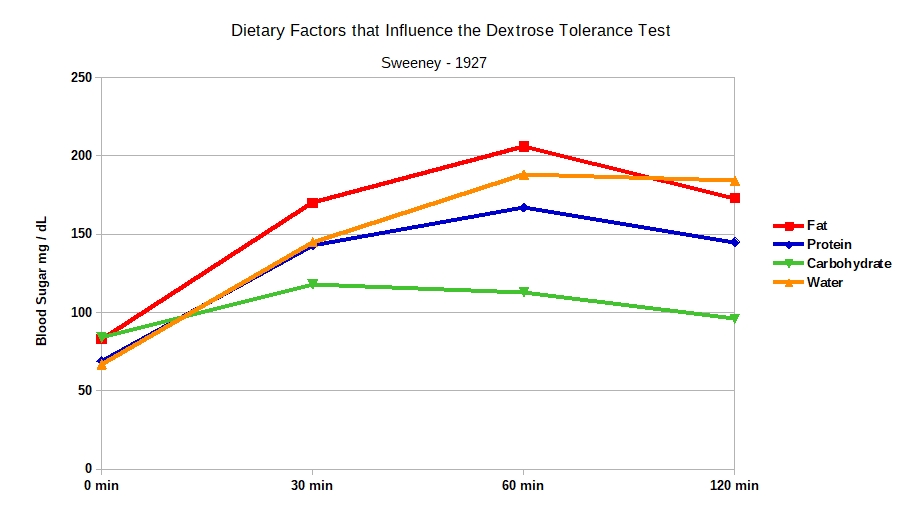
    Way back in 1927, J. S. Sweeney assigned healthy, young medical students into four dietary groups: A high-carbohydrate diet; a high-fat diet; a high-protein diet; and a fasting diet.

    After only two days on their highly improbable diets, the students were given a glucose tolerance test.

    Which diet had the best result for the Glucose Tolerance Test?
    Read more ⇨

  • Wheat and Inflammation

    William Davis is largely responsible for the low-wheat, low-gluten diets with the publication of his book Wheat Belly. In this book he states that we live in a ‘whole grain world’ and that wheat is responsible for the majority of our modern illnesses including wheat.

    Find out what the role of wheat is in inflammation.

    Read more ⇨

  • WHOs Guidelines Review – Image Credits

    The Men Who Made Us Fat Director Boulding, C Scriptwriter Peretti, J Producer Boulding, C Produced by: Fresh One Productions for the BBC Date 2012 Rights Fair Dealing, Fair Use…

  • Bread Does Not Make You Fat

    Most people are under the impression that starchy foods such as bread and potatoes make you fat.

    This is not the case - unless you cover your bread and potatoes with high-fat foods such as cheese, butter or sour cream.

    Excess sugars and carbohydrates are stored as glycogen - not fats. Carbohydrates are not converted to fats. Animals, bacteria and fungi convert glucose to glycogen which is the form that glucose is stored.

    Except in abnormal, extreme conditions, carbohydrates are not converted to fat in humans.

    Fats make you fat - not carbohydrates.

    Read more ⇨

  • Global Burden of Disease 2010

    The Global Burden of Disease Study commenced in 1990 as a World Bank commissioned initiative that measures the health impact of disease and injuries. It introduced the term disability-adjusted life year (DALY) as a new measure to quantify the burden of diseases and injuries.

    It is managed by the Institute for Health Metrics and Evaluation at the University of Washington with the purpose of "understanding the current state of population health and the strategies necessary to improve it."

    Read more ⇨

  • The Evidence Against Eric Westman and William Yancy

    Eric Westman and William Yancy are medical doctors associated with Duke University School of Medicine in North Carolina, where they are associate professors.

    They are prolific authors associated with ketogenic and high-fat, low-carbohydrate diets. They have both received funding from Robert C. Atkins Foundation which supports research into low-carbohydrate nutrition.

    Read more ➱

  • Letter to Diggers – October 2018

    In the Spring 2018 edition of Diggers, Bel P claims that What The Health has been “expertly torn to pieces”. No effort has been made to justify this claim. What The Health web site has listed approximately 300 references for the movie with the elapsed time that the information was presented.

    In the absence of a valid critique of What The Health, I will present some evidence presented by the movie for the health benefits of a whole-food, plant-based diet. All references provided are from primary sources for which I have the paper or electronic copy.

    Read more ➱


Search


WHO's recommendations on saturated fat are out of date, expert team says.
However, the study has been funded by the dairy and beef industries.
Discover how industry-funded research is deceiving the public.


Low-carboydrate Diets - The Myths Why are Eggs NOT OK? Dairy and Wheat - What you did not know Carbohydrates DO NOT cause diabetes
Truth and Belief
Low-carbohydrate Mania: The Fantasies, Delusions, and Myths

Center for Nutrition Studies

Center for Nutrition Studies