Immune System
-
The Nature of Food Allergies
Food allergies have become a major concern with parents, health practitioners and school administrators. However, the estimates of prevalence of allergies varies widely.
A commonly accepted definition is an “adverse immune response that occurs reproducibly on exposure to a given food and is distinct from other adverse responses to food, such as food intolerance, pharmacologic reactions, and toxin-mediated reactions.”
However, most people are not going to make such a fine distinction between food allergy and food intolerance. Non-celiac gluten-sensitivity (NCGS) does not cause an IgE response so with this definition it not classed as a food allergy.
Dairy, in particular, cow’s milk and gluten, wheat and grains are commonly avoided as a result of concerns about food allergies.
Read more ➱ -
What is the Problem with Wheat and Gluten?
Gluten-free foods is a huge industry. It is estimated that approximately 2% of the US population, that has not been diagnosed with celiac disease, is consuming a gluten-free diet.
The CSIRO reports that, “as many as 1 in 10 Australian adults, or approximately 1.8 million people, were currently avoiding or limiting their consumption of wheat-based products. Women were more likely to be avoiding wheat than men. The survey also revealed that over half (53%) of those who were avoiding wheat were also avoiding dairy-based foods.”
There is an increasing awareness of the importance of gut flora and its role in health.
People who embark on gluten-free diets frequently have significantly impaired health outcomes due to changes in gut bacteria.
At one clinic in Rome, only 30% of people suffering from irritable bowel syndrome (IBS) were sensitive to gluten.
At another clinic, in Maryland USA, only 6% of those suffering from IBS were affected by gluten.
It is apparent that digestive problems are much more complicated than they first appear.
Read more ➱ -
Eggs and the Questionable Benefits of Choline
According to the Australian Eggs website,
Choline is used by the body for metabolic processes such as liver function, normal brain development, nerve function and muscle movement. It’s particularly important during pregnancy to support foetal brain development."
Egg consumption has consistently been shown to be associated with an increase in prostate cancer, so what is the story?
Read more ➱ -
What are the Nutritional Benefits of Eggs?
The nutritional benefits of eggs is highlight in the Australian Eggs’ OK Everyday campaign. Just how accurate is the assertion that “eggs aren’t just delicious, they’re incredibly nutritious. There’s a good reason eggs are often referred to as nature’s multivitamin – they’re one of the healthiest foods you can eat”.
Let’s examine some of the claims that are being made.
Read more ➱ -
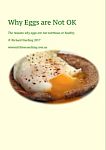
Eggs are Not OK
Australians’ usual egg consumption is a document prepared by researchers at the CSIRO. The CSIRO is the premier Australian government-funded research organisation.
The conclusion of this document states:
Eggs provide a low cost, convenient source of protein and other key nutrients. Our results [from the Healthy Diet Score survey] suggest their inclusion in the diet is associated with a higher diet quality, in particular higher consumption vegetables and lower consumption of discretionary foods.This document is a marketing document. It needs a lot of imagination to make such a conclusion from the CSIRO’s published research papers. This conclusion also contradicts a number of other studies that show consuming eggs is detrimental.
I sent an email on 28th October 2017 to the lead author of this document, Dr Gilly Hendrie. Hendrie is also the lead author of a number of journal articles relating to the Healthy Diet Index. A copy of this email can be found at CSIRO Healthy Diet Score and Egg Consumption in Australia.
The response will be published when it is received.
Read more ➱ -
CSIRO Healthy Diet Score and Egg Consumption in Australia
In May 2015, the CSIRO (Australia) Healthy Diet Score survey was launched. This survey describes Australian’s self-reported diets and their compliance with the Australian Dietary Guidelines. As at June 2016, more than 85,000 people have responded.
This survey was used to justify the “Eggs are OK every day” campaign. This is despite the fact that the only measurable health outcome was weight status and despite the fact that there is only a fair correlation between two different self-reported dietary surveys that were performed a week apart.
Read more ➱ -
Worried about whether you should be eating eggs?
The Australian Heart Foundation has the following comment regarding eggs.
Worried about whether you should be eating eggs? They're really nutritious and it's fine to have them regularly as part of a healthy diet. Eggs contain good quality protein, 11 vitamins and minerals, and are a source of healthy fats including omega-3 fats. One egg has about 5 g of fat – but most of this is unsaturated, a fat that you need to be healthy. An egg contains only about 1.5 g of saturated fat and no trans fat. As part of a healthy balanced diet you can eat up to 6 eggs each week without increasing your risk of heart disease.
However, according to the Physicians' Health Study, doctors consuming 7 or more eggs per week had a 31% increase in all-cause mortality compared with those consuming less than 1 egg per week. With diabetic physicians, the association was much higher with the increase in mortality doubled.
Read more ➱
Font Resizer
Search
However, the study has been funded by the dairy and beef industries.
Discover how industry-funded research is deceiving the public.
Carbohydrates DO NOT cause diabetes
Truth and Belief

Discover why researchers, popular commentators and the food industry is more concerned with maintaining corporate profits than ensuring that we have valid health information.Who is going to get wealthy by encouraging people to eat their fruit and vegetables?
Featured Posts
Why Consume a WFPB Diet?Brief Overview of WFPB Diets
Introduction
Where do You Get Your Protein?
The Problem with Cow's Milk
Breast, Endometrium and Ovarian Cancers
Eating Red Meat is Not Natural
Taiwan, Buddhists and Moderation
Autoimmune Diseases, Biomimicry and Type 1 Diabetes
Glucose Tolerance
7th-day Adventists and Health
Worried about eating eggs?
How Cooking Changed Us
Deception from The BMJ
Endometriosis is Curable
Changes to our Health Indicators
Cause of Type 2 Diabetes

Center for Nutrition Studies

Last Modified
- DNA, Genetics and Epigenetics 26 July 2026
- Eating Red Meat is Not Natural 25 July 2026
- Why Consume a Whole-food, Plant-based Diet 25 July 2026
- Information About Breast, Endometrium and Ovarian Cancers 25 July 2026
- Dr James Muecke Australian of the Year in 2020 25 July 2026
- Seventh-day Adventists and Health 25 July 2026
- A Reading List 24 July 2026
- The Problem With Cow's Milk 24 July 2026
- Where do You Get Your Protein 24 July 2026
- Harvard Study Shows Plant Protein Consumption Reduces Mortality 23 July 2026
- About Richard Harding 23 July 2026
- Hunter Valley Natural Therapies Talk - 22 August 2017 23 July 2026